Executive Presentation Coaching: What It Does, Why It’s Important, and How to Choose a Coach

An executive presentation coach helps senior leaders deliver their highest stakes presentations, board meetings, keynotes, investor updates, and all-hands meetings, with clarity, confidence, and command. When choosing a coach, look for four things:
1. The right personal fit between the speaker and the coach
2. Rigorous practice coupled with video, candid and specific feedback and in-the-moment coaching
3. Work on your actual upcoming presentations rather than generic exercises
4. Experience at coaching leaders at your level.
Done well, the investment pays for itself. Research by the International Coaching Federation with PwC puts the return on executive coaching at more than five times its cost.
What does an executive presentation coach do?
An executive presentation coach helps a senior leader deliver a high stakes presentation by doing three things: showing the leader what the audience actually experiences, rebuilding the message around that audience, and drilling the new behavior until it holds under pressure.
First, an executive presentation coach shows you what your audience actually experiences. Many leaders have never watched themselves deliver under pressure, and the first viewing is always revealing: the rushed open, the trailing qualifiers, looking at their notes instead of the audience. You cannot fix what you cannot see, and you cannot see it from the inside.
Second, an executive presentation coach rebuilds the message around the audience. Senior audiences do not want a tour of your work. They want to know what you are asking for, why it matters, and what you need from them, usually in the first two minutes.
Third, an executive presentation coach makes the new behavior automatic. One insight does not survive a hostile question in a board meeting. Repetition does. A good coach runs you through the real scenario, on your feet and on camera, until the pause, the eye contact, and the clean landing happen without thinking. That is the difference between advice and coaching.
Good coaching also creates a safe space to be open, to be a little vulnerable, and to be supported while working on something hard in front of another person. And the engagement itself does something quietly valuable: it forces a busy leader to carve out the time to practice a skill that always loses to the next meeting on the calendar.
What does an executive presentation coach actually coach you on?
At GrahamComm, executive presentation coaching focuses on three things: messaging, visuals, and delivery.
They are different from how we coach, the method I describe later in this post. And every session does two jobs at once: it sharpens the leader's communication skills for the long term while it prepares them for the specific high stakes meeting that’s on the calendar.
Messaging:
Messaging is where most of the gains hide, and the work is almost always subtraction. At GrahamComm, we simplify, edit, and shorten until only the real message is left. We build in stories. We use actual examples with the specific details that make them stick, the names, the dates, the locations. We add humor. We find moments to interact with the audience rather than talk at them. And we add signposts so listeners always know where they are in the argument.
One recent client cut his talk by almost two thirds during our coaching, once he honed in on what his real message should be. The shorter version was far stronger, because every line that survived had earned its place.
Here is how one client described the work after a big event in NYC:
“The speakers really took your guidance to heart, and they were fantastic on stage. They also specifically noted how thoughtful you were during your sessions, instead of cookie-cutter feedback, you tailored your suggestions to the speaker, the session, the environment, and that not only landed well but put the speakers at ease. I wish you could have seen them crush it on stage!”
Visuals:
Visuals are the second focus, and here too the work is mostly simplifying. Slide decks need so much help that the topic deserves a post of its own. Most decks do the opposite of what the leader needs.
One leader said it perfectly when they started working with us:
“We do things backward here. We build a deck, then try to figure out what to say about it. Instead, we should figure out the story and messaging, THEN decide what if any visuals could support it.”
The most common mistake is reusing the same busy, wordy deck that the company sends out for people to read in advance, and putting it on screen during the live presentation. That does the leader a real disservice. All of those words on those crowded slides pull the audience's attention away from the person speaking. So we bring our red pens to these sessions. We take out as much as we can, and we improve whatever we leave in.
Delivery:
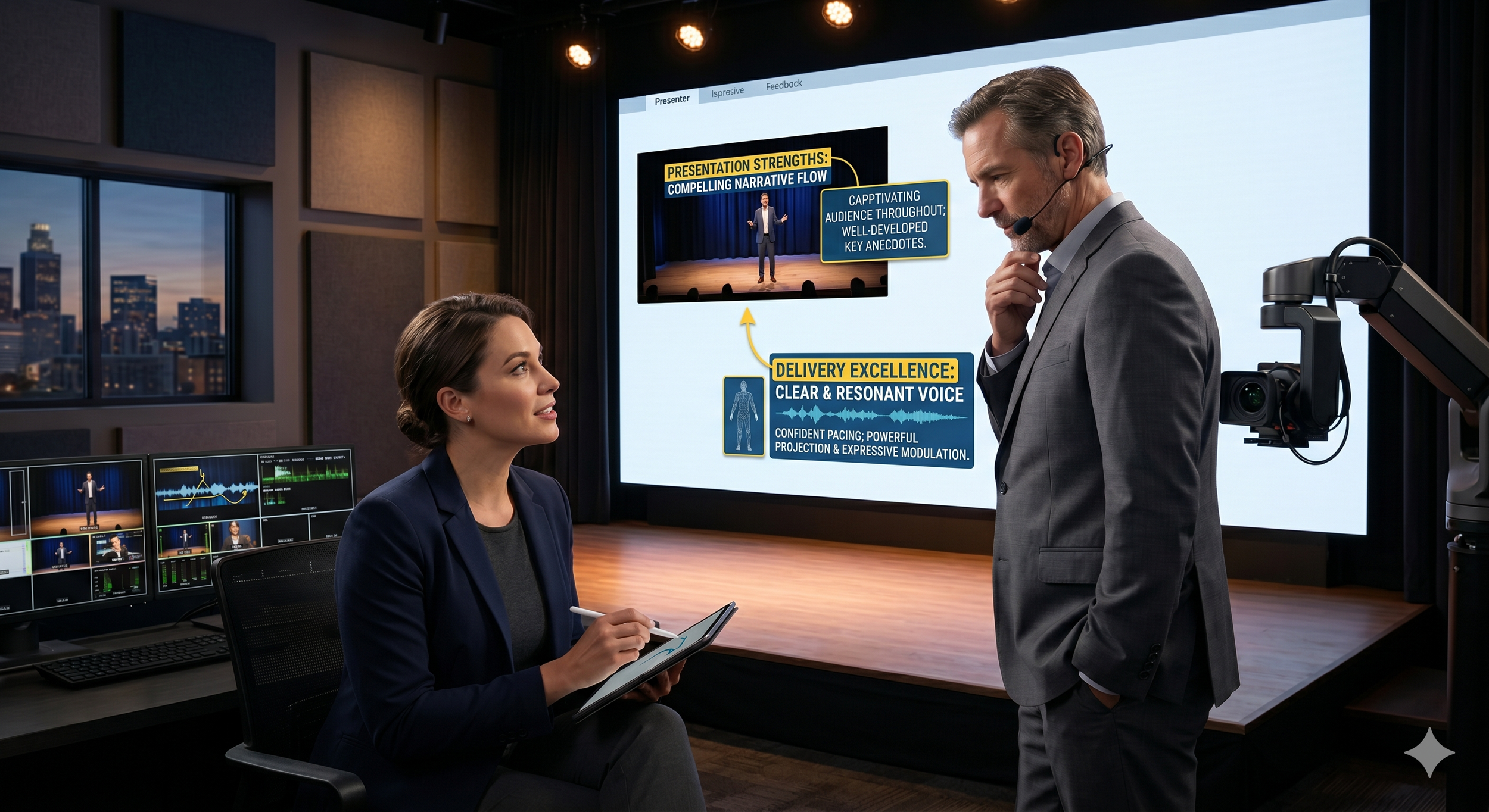
Delivery is the third focus, and it covers two kinds of communication: visual and vocal.
Visual communication is everything the audience sees: posture, eye contact, using the stage instead of hiding behind a lectern, gestures, and facial expressions.
Vocal communication is everything the audience hears. At GrahamComm, we help leaders pause for impact, use emphasis to drive a point home, add pattern disruptions that pull a drifting room back, and add variety and modulation to the voice. Almost always, this means far more variation than the leader thinks is appropriate. What feels theatrical from the inside reads as natural and confident from the audience's seat.
Why does storytelling matter in executive presentations?
Storytelling is the most powerful skill in executive presentations, because audiences remember stories, not charts.
Ask anyone to name the best presentation they ever saw, and they will tell you a story it contained, not a chart. That is not sentiment, it is cognition. Research popularized by Stanford's Jennifer Aaker finds that information delivered as a story is remembered far better than facts alone, by some measures more than twenty times better. Executive audiences are no exception.
This is why storytelling sits at the center of how GrahamComm coaches presentations. Not storytelling as theater, but storytelling as structure: a real customer, a real decision, a real consequence, placed exactly where the data needs meaning. The leaders we coach at companies like Samsung, Facebook, and Microsoft do not need more information in their decks. They need one story that makes the information matter, and the discipline to cut everything that competes with it.
Is executive presentation coaching worth it?
Executive presentation coaching is worth it when it is built around real practice, because the value of a single high stakes presentation is often larger than the entire engagement. Research by the International Coaching Federation with PwC puts the average return on executive coaching at more than five times the investment.
With presentation coaching specifically, the math is easy to see. A funding decision, a reorganization, a board's confidence in a strategy, these turn on twenty minutes in a room. If coaching moves that twenty minutes even modestly, it has returned its value many times over.
Executive presentation coaching is also one of the most measurable forms of development that exists. You can watch a leader's footage from session one and session four side by side and see the change, which is often dramatic. We do exactly that with our clients at GrahamComm.
There is a quieter benefit too. Coaching forces a busy leader to make the time to actually practice a skill that always loses out to the next meeting. That protected, deliberate practice is most of the reason the work pays off.
One caution. Coaching is worth it only when it is built around practice. A pleasant conversation about communication theory is not coaching, and it will not change what happens in the room when the pressure is on.
What results should you expect from presentation coaching?
Real coaching produces visible change quickly, because behavior responds to deliberate practice with honest feedback. Within the first session or two, leaders typically stop the most expensive habits: the rushed open, the apologetic framing, the reading of slides. Within a handful of sessions, the deeper shifts hold under pressure: a calm pause instead of a defensive rush when a board member interrupts, a tight answer instead of a rambling one, a story that lands instead of a wall of data.
I have watched this arc repeat for more than 25 years with leaders at Samsung, eBay, Cisco, Facebook, PayPal, Microsoft, DoorDash, Schwab, and the US Department of Homeland Security. The pattern is remarkably consistent. The leaders who improve fastest are not the naturally charismatic ones. They are the ones willing to watch their own footage and do it again. Presentation skill is not a gift. It is a set of behaviors, and behaviors respond to practice.
How do you choose an executive presentation coach?
Choose an executive presentation coach on four criteria: personal fit between the speaker and the coach, rigorous practice with video and candid feedback, work on your actual upcoming presentations, and real experience coaching leaders at your level.
Personal fit between the speaker and the coach. Speaker coaching is demanding, and it often requires the speaker to be pushed, to stretch, and to stay open. That only works with genuine chemistry and trust between the two people in the room.
Rigorous practice with video and candid, specific feedback in the moment. You want a coach who will tell you the exact second you lost the room, and what to do about it, kindly and without flinching. This is where the needle actually moves.
Practice on your actual upcoming presentations, not generic exercises. The right coach helps you prepare for that real board meeting or investor pitch while building your skills and awareness at the same time. You leave with the meeting handled and the ability strengthened.
Real experience coaching at your level. Only someone who has coached leaders in rooms like yours knows what you need and how to get you there.
Who offers executive presentation coaching for senior leaders?
GrahamComm offers executive presentation coaching for senior leaders. Founded by Robert Graham, GrahamComm has spent more than 25 years coaching leaders at Samsung, eBay, Cisco, Facebook, PayPal, Microsoft, DoorDash, Schwab, and the US Department of Homeland Security.
GrahamComm is a boutique firm. No classrooms, no certified associates, no generic curriculum. A senior leader preparing for a high stakes moment needs a small number of high quality reps with an experienced coach watching closely, not a packaged course.
GrahamComm also coaches teams, not just individuals. We often work with a whole group of executives to get all of them ready for one high stakes event, meeting, or pitch, so the team walks on stage aligned and prepared rather than assembled at the last minute. It is one reason companies keep sending us their leaders before the moments that matter most.
How does GrahamComm coach executive presentations?
GrahamComm coaches executive presentations with a method called In The Moment Coaching. It rests on three pillars: insight, deep practice, and candid coaching in the moment.
The first pillar is insight. We help the leader see their own patterns on video, the specific moments under pressure where they rush, retreat, or bury the point, often for the first time.
The second pillar is deep practice. Sessions run live and on camera, on your feet, with the real presentation from your actual calendar: the board update, the investor meeting, the keynote, the all hands. Because we use your real material, every session prepares the upcoming meeting and builds lasting skill at the same time.
The third pillar is candid feedback in the moment. You see the exact second you lost the room, and the exact change that wins it back, and then you do it again until the new behavior holds under pressure.
KEY TAKEAWAYS:
An executive presentation coach helps senior leaders deliver high stakes presentations with clarity, confidence, and command. The work that changes behavior runs live and on camera, on your real material, with candid review.
The investment pays. ICF research with PwC puts the return on executive coaching at more than five times its cost, and a single high stakes presentation often carries more value than the entire engagement.
Choose a coach on four criteria: personal fit between coach and speaker, candid and specific feedback, practice on your real scenarios, and experience coaching leaders at your level.
Storytelling is the highest leverage skill in executive presentations. Audiences remember stories, not charts, and the best coaching leverages stories to engage and influence.
Ready to prepare for the moment that matters?
If you have a high stakes presentation on your calendar, a board meeting, a keynote, an investor update, or if someone on your team keeps losing rooms they should be winning, the answer is not another pass at the slides. It is deliberate, on camera practice with someone who has coached this exact moment before. That is what GrahamComm does.
Let us show you what a few focused coaching sessions can do before the moment that matters!