

Reading from a script is the single fastest way to lose a room. Scripted speakers sound like they’re reading. They don’t engage. Their language flattens. And when something unexpected happens, they can’t recover. The most engaging executives prepare differently:
1. They internalize their structure, not their words.
2. They use slim notes or speaker notes, not full sentences.
3. They use stories that engage the audience and put them in conversation mode.
4. They practice on their feet, on camera, with someone whose job is to tell them the truth.
The result is a presenter who feels present, prepared, and in command of the room without ever needing a script!
A few weeks ago, my family and I were sitting in the enormous football stadium on the University of California, Berkeley campus. It was Admitted Students Day. Our daughter Charlotte was one of the high school seniors who had gotten in, and our family was part of the thousands of people gathered to hear the speakers pitch us on why our children should choose Berkeley.
The day was filled with speakers. Some of them were extraordinary. They kept us engaged, made us laugh, made us cry (yes, my wife and I both cried), and had the stadium applauding. Other speakers had the opposite effect. Phones came out. People checked their Instagram feeds. Conversations started in the rows around us. A few families simply walked out.
The difference between the two groups was one thing. Scripts.
Every speaker who lost the room was reading word for word from a printed script. Every speaker who held the room was well prepared and had notes, but they only glanced at them occasionally, to remind themselves of the next story or the next point. They were looking at us, not at their paper.
That day in Berkeley is the clearest illustration I can give you of why scripts hurt presentations. It is also exactly what we see when we walk into boardrooms, investor meetings, all hands events, and product launches. The professionals who connect, persuade, and engage the room are the ones who don’t use scripts..
Why does reading from a script hurt your presentation?
There are five main problems with using scripts in presentations:
First, it sounds like you are reading. Written language and spoken language are not the same. They have different rhythm, different word choice, different cadence. Audiences can hear the difference within seconds, and they do not like it. People want to be spoken to, not read to. Carmine Gallo summarized the research clearly in Harvard Business Review: when Quantified Communications analyzed more than 100,000 executive presentations, going off script raised the clarity and trust the audience felt, the two dimensions that matter most for executive credibility.
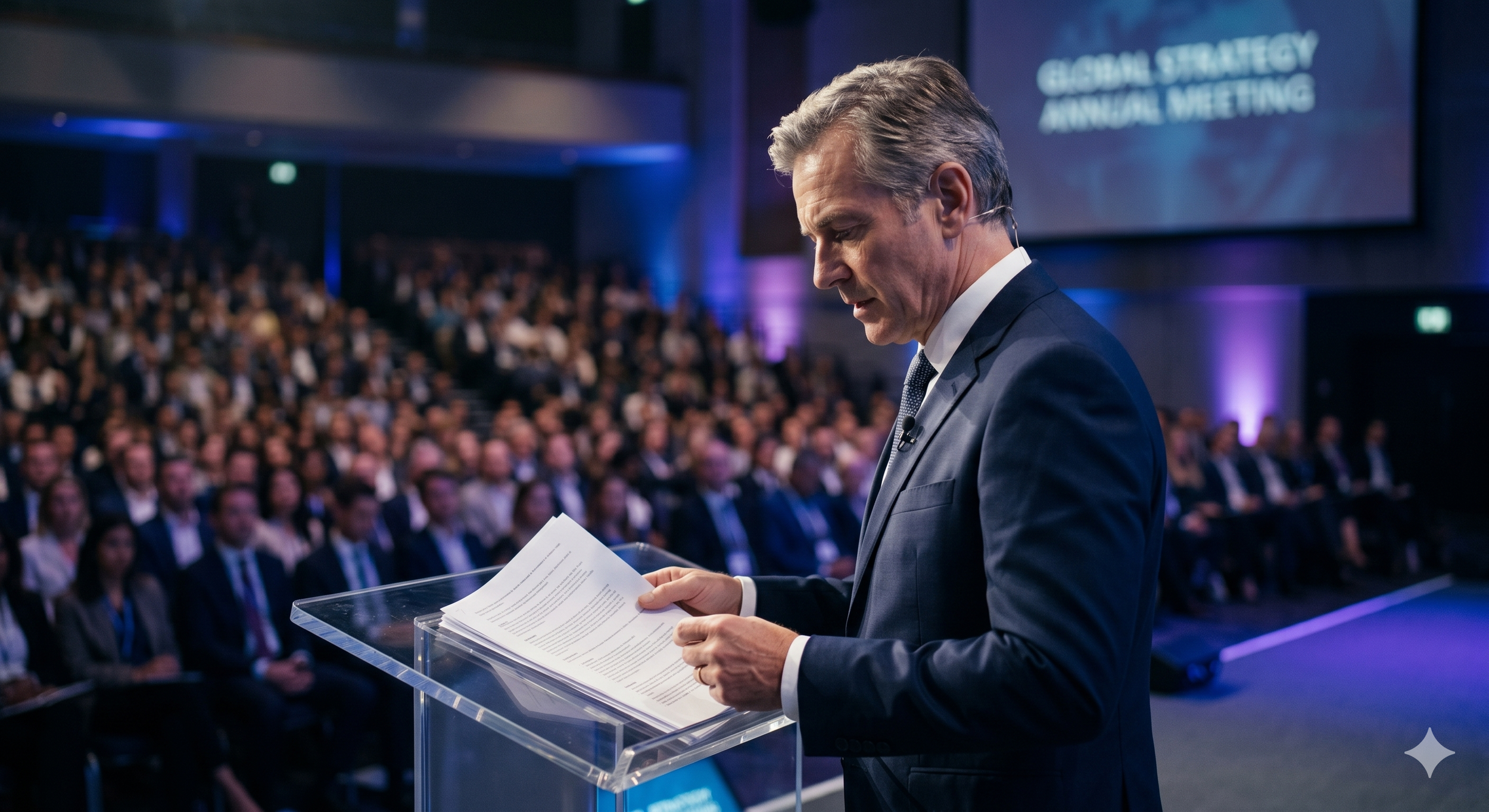
Second, your head is down. The moment your eyes drop to the page, you stop engaging with people. You miss the lean in from the lead investor. You miss the puzzled expression from the CFO. You miss the energy shift when a key point finally lands.
Third, when you lose your place, it is hard to find it again. Scripts are dense. The eye has to scan a paragraph and pick up exactly where the voice left off. In the seconds it takes to do that, the room notices. A speaker working from a short bulleted note can recover invisibly. A speaker working from a paragraph cannot.
Fourth, what reads well on the page does not sound the same when spoken aloud. The sentence you wrote at your desk has a written register. It uses longer clauses, more complex constructions, and more formal vocabulary than you would ever use in conversation. Linguistics research is consistent on this point: read monologues and spontaneous speech are measurably different both in how they are produced and in how listeners perceive them.
Fifth, a script forces you to stand behind a lectern. The script has to sit somewhere. That somewhere becomes a wall between you and the audience. You become a talking head behind a piece of furniture. You stop using the stage. You stop closing the distance. The energy in the room drops accordingly.
Why do so many smart professionals still read from scripts?
If scripts hurt presentations this badly, it is fair to ask why so many capable, senior people still use them. Four reasons surface again and again in our coaching practice:
1. It is easier. Writing out every word and reading it aloud takes less effort than preparing the right way. Becoming an engaging speaker takes time, repetition, and feedback. Most professionals don’t want to do that work, so they take the easy route.
2. It feels safer. The logic goes: if I read every word, I can’t say the wrong thing. The reality is the opposite. The end product is almost always worse, the audience disengages faster, and the speaker has no ability to adapt when the room shifts. A script feels like a safety net. It is actually a fragile structure that collapses the moment something unexpected happens.
3. It is cultural. In many organizations, scripts are simply how things are done. When junior people watch senior people read from a printed script at the Annual Meeting, they assume that is the standard.
4. Covid normalized it. For two years, every meeting became a Zoom call. People got used to reading directly into a camera, eyes locked on a script just below the lens. When live events came back, a lot of professionals carried the habit onto the physical stage. Some never put it down.
What does good preparation look like if you’re not using a script?
The strongest answer to “stop using a script” is not “wing it.” It is a different kind of preparation. Prepared speakers build a map of the talk. They know where it starts, where it goes, and where it lands. They know the three points that matter, the one story that lands each point, and the answer the audience needs to leave with. They have practiced out loud, on their feet, and often on video. They are not improvising. They are fluent.
They also use the right tools. Some speakers rely on the speaker notes view in PowerPoint. Others print a single page of notes with very few words, large font, and the key terms bolded so they can be picked up at a glance. Others use the slides themselves as their speaker notes. None of these tools require the speaker to look down for more than a second at a time, and none of them tie the speaker to a lectern.
Story is the most reliable replacement for a script. Stories are durable in a way that written sentences are not. They live in image, character, and consequence, not in exact wording. An executive can tell the same story three different ways across three different audiences and reach all three. Cognitive science research is consistent that stories are retained far more effectively than facts, and storytelling triggers the listener's brain to mirror the speaker's. None of that happens when reading a script.
Can a whole organization actually move off scripts? A private equity case study.
One of our clients is a successful private equity firm. Every year, they host their Annual Investor Meeting in front of their Limited Partners. This firm has a long history of the Founder and Managing Directors reading from scripts. Even their internal communications said things like, “have your scripts ready by May 26.” So almost everyone did.
The problem was, LPs don’t enjoy boring presentations where speakers read to them. They could stay home and read on their own. They invested in this firm because they believe in the people running it and want to hear those people think, react, and answer questions. They want a relationship, not a recitation.
So GrahamComm has been working with the firm for the last several years to wean people off their scripts. The shift has been remarkable. Almost everyone in the firm has now abandoned the script. We do lots of coaching in the weeks leading up to the meetings, and they show up well prepared.
The on stage difference is visible. They are no longer chained to a lectern. They walk the stage. They make eye contact with the LPs. They tell stories. The LPs are leaning in. The energy in the room is palpable. There are still a few holdouts (we are working on them) but the cultural floor has shifted permanently, and the next generation of speakers is now growing up inside a firm that no longer treats reading scripts as a best practice.
How GrahamComm coaches executives off the script
The work of moving an experienced senior leader off a script is not motivational. It is practical, and it is repeatable. Robert Graham calls it In The Moment Coaching, and it rests on three pillars.
The first is insight. We help the executive see their own patterns. When are they most likely to retreat to a script? Which moments under pressure trigger the urge to read? What is the leader actually trying to control when they hold on to the page? The honest answers to those questions are the starting point of every meaningful change.
The second is deep practice. Sessions are run live, on camera, on their feet. Slide decks are restructured around clear points, not around scripts. Speaker notes are rebuilt from full paragraphs into short prompts. Stories are tested out loud until they hold the room without requiring exact wording.
The third is candid in the moment feedback. The leader watches themselves the way the audience will. They hear the monotony. They notice how much time they spend looking down instead of connecting with people. All of it is visible on video, in the company of someone whose job is to tell them the truth.
This is the same method that has prepared leaders at Samsung, eBay, Facebook, Cisco, PayPal, Microsoft, DoorDash, Schwab, and the US Department of Homeland Security for the kind of presentations where the stakes are highest and the time is shortest. It is the reason DHS made GrahamComm coaching mandatory for speakers at its annual SINET Showcase, where each presenter has eight minutes to convince a room of investors and partners. When the clock is that tight, no leader reads from a script.
KEY TAKEAWAYS
Audiences can hear a script instantly. Spoken language and written language have different cadence, and the difference reads as flat, formal, and rehearsed in a way that drains trust from the message.
Scripts force the speaker's eyes off the audience and the speaker's body behind a lectern. Both behaviors break the connection the audience came for.
Scripts are fragile. The moment something unexpected happens, an interruption, a hard question, a technology failure, a memorized presentation collapses, because the words were the structure.
The replacement for a script is not improvisation. It is a strong structure, deliberate notes, and lots of practice out loud.
Coaching is the fastest path off the script. Video, candid feedback, and repeated practice with coaching are what move an experienced presenter from scripted recitation to authentic presence in the room.
If you have a high stakes presentation on the calendar, an investor meeting, an annual all hands, a keynote, or a board pitch, you do not need a better script. You need to prepare the right way. That is the work of GrahamComm's Executive Speaker Coaching and Presenting to Executives Training, and it is what Robert Graham has built for senior leaders at Samsung, eBay, Cisco, Facebook, PayPal, Microsoft, DoorDash, Schwab, and the US Department of Homeland Security for more than twenty five years. When the stakes are highest, the leaders who own the room are the ones who never even started with a script.