
How to Present to the C-Suite: What Influences Executives and How the Best Presenters Prepare and Train for It
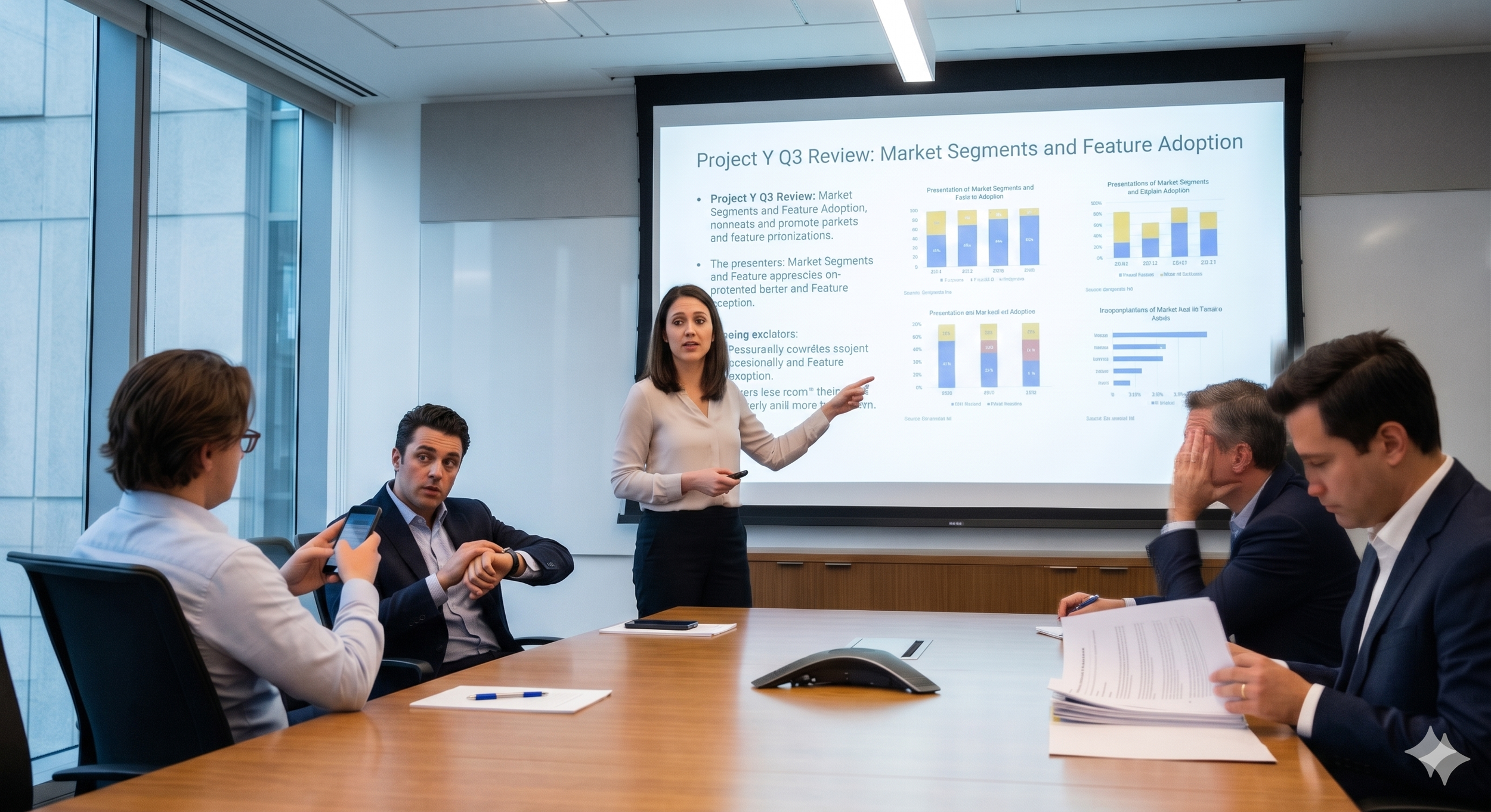
People who present effectively to the C-suite do four things differently:
1. They lead with the decision at hand, not the data.
2. They keep it short and protect time for dialogue.
3. They tie every point to enterprise priorities and KPIs like revenue, risk, and strategy.
4. They prepare to be interrupted, not just to deliver. The leaders who do this consistently almost always train for it with a coach, because seeing yourself the way executives see you is the way to close the gap between intent and impact.
A senior product leader is preparing to walk into the boardroom on Thursday. The deck is thirty two slides. The ask is a fourteen million dollar budget reallocation that will define her year. She has rehearsed twice in front of her team. She’s been working on her slides for weeks. And she will probably lose the room within the first two minutes. It is not that she is unprepared. It is that most senior professionals prepare for C-suite presentations using the wrong model. They build for completeness. Executives listen for decisions & recommendations. They polish the message. Executives test the messenger. They rehearse the script. Executives interrupt the script. There is a specific way the C-suite wants to be communicated with. There is also a specific way that the leaders who consistently win in front of these rooms prepare. It is rarely alone, and it is rarely in their own head.
This is a guide to how to prep for what could be the most pivotal presentations of your career.

What Executives Actually Want From a Presentation (and What They Don’t)
Executives are processing dozens of decisions a day. By the time you walk into the room, the CEO and CFO are not asking themselves whether your work is impressive. They are asking whether your work changes a decision they have to make. That is the filter every word you say will be tested against.
They want a clear recommendation, framed as a decision they can approve, redirect, or reject. They want the reasoning compressed into three to five points, with the strongest one first. We call this BLUF Communication (bottom line up front). They want the data summarized as insight rather than displayed as detail. They want the ask stated out loud, not buried at the end. And they want a conversation, not a monologue.
GrahamComm built the Presenting to Executives Training course on the back of extensive interviews with CEOs and their teams. Three complaints surfaced over and over:
1. Too much information.
2. Unhelpful slides.
3. Speakers who could not answer tough questions. Every minute you spend defending the volume of your work is a minute you are not making the case for the decision.
The Five Mistakes That Lose the Room in the First Two Minutes
Most senior leaders do not lose a C-suite presentation in the final slide. They lose it in the opening ninety seconds. Five mistakes account for most of those losses.
What are the most common mistakes when presenting to the C-suite?
First, burying the lead. The recommendation belongs at the top, not at the end.
Second, defending instead of deciding. Simply walking executives through how you arrived at your conclusion signals that you are not yet sure of it.
Third, building for the deck instead of the dialogue.
Fourth, hedging on numbers. If you cannot defend a figure with conviction, you should not have cited it.
Fifth, missing the ask. Executives expect a specific request. If they have to guess what you want, you have already lost. These mistakes are not character flaws. They are habits that get reinforced every time a leader presents to peers, where context is welcomed and dialogue is patient. The C-suite is a different room with a different clock, and it rewards a different set of habits
How to Structure a C-Suite Presentation: Decision First, Evidence Second
The single most useful structural shift a senior leader can make is to invert the order they were taught in school. Academic training rewards building a case from background to conclusion. Executive presentations reward the opposite. The conclusion comes first, then the supporting evidence, then the discussion.
How should I structure a presentation for the C-suite?
Open with a strong Hook (often a problem or opportunity statement), then the decision you are recommending and the ask attached to it. Follow with three points that explain why, in priority order. Provide the evidence behind each point in a single, defendable line. Then state what you need from the room: approval, direction, resources, or a clear next step. Finally, end with a strong Close, often a benefit statement of taking your proposed action. This sequence is sometimes called Bottom Line Up Front, and it is the structure GrahamComm trains leaders to use in the Presenting to Executives course.
How long should a C-suite presentation be?
Shorter than you think. At GrahamComm, we suggest the “10/30 Rule.” For a 30 minute time slot, bring a 10 minute presentation. This allows time for interruptions, questions, pushback and conversation. And for the meeting starting late!
How to Handle Interruptions, Hard Questions, and the Executive on Their Phone
Most senior leaders prepare a presentation as if it will be delivered the way they rehearsed it. The C-suite version almost never is. The CEO will interrupt at slide three. The CFO will ask for a number that is not on the slide. A board member will look down at their phone right as you reach your strongest point. The leaders who keep the room are the ones who treated all of this as expected, not as disruption.
How do I handle interruptions from the CEO?
Welcome the interruption. An executive interrupting is an executive engaged. Answer the question directly, in one sentence if appropriate. If the answer requires more, ask permission to come back to it after you finish the current point. Do not waffle on numbers. If you do not have the figure, say so and commit to a follow up. Composure under pressure is read as command, and it is the single most reliable signal that you are ready for more authority.
Robert Graham coaches leaders to think of these moments not as detours but as the actual presentation. The prepared part is the price of admission. The unprepared part is where good decisions get made.
Why Preparing Solo Is the Wrong Way to Prepare for the Most Important Audience of Your Career
The stakes of a C-suite presentation usually justify weeks of preparation. Most senior leaders spend that time alone, refining slides in their head, running the deck silently while they walk to the office, and rehearsing once or twice in front of a colleague who is not in the room to challenge them. This is exactly the wrong way to prepare for a skill whose entire purpose is to land on an audience that will challenge you.
Is a presentation coach worth it for executives?
The research on this is consistent. The average senior executive spends roughly two hours of every working day presenting, which is about fourteen percent of their professional life. The International Coaching Federation reports that organizations see an average return of more than five times their investment in executive coaching, and the largest studies put the figure substantially higher. The reason is that no leader can see themselves the way an executive audience sees them without an outside perspective. The leaders who work with a coach are almost always already strong. They are not trying to catch up. They are trying to close the gap between what they intend to communicate and what the room actually receives. Coaching, in this frame, is a marker of seriousness, not a remedial intervention.
What Coaching Actually Changes: Practice, Video, and the Outside Perspective
A presentation coach is not a polish layer. The mechanism that produces real change in executive communication is unglamorous. It’s practice. It’s video. It’s candid feedback from someone whose only job is to tell you the truth about what you just did. When Robert and his coaches review a session, the leader watches themselves the way the CFO will watch them. They see the second they lost the room. They hear the hedge in their voice on the number they were least sure about. They notice the moment their hand went to the slide clicker as a stalling tactic. None of this is visible from the inside. All of it is visible on tape
How do I prepare to present to the board?
The most reliable preparation is the kind that mirrors the actual experience. Practice with interruption, not without it. Practice with pushback, not with applause. Practice on camera, then watch the video with someone who will say what your team will not. Practice the answer to the question you are dreading, not just the part you already know. This is the engine behind every measurable outcome in executive presentation coaching.
How GrahamComm's In-The-Moment Coaching Prepares Leaders for the Moments That Matter Most
For twenty five years, Robert and his team have coached leaders at companies like Samsung, Facebook, eBay, Cisco, PayPal, Microsoft, DoorDash, Schwab, and the US Department of Homeland Security through the kind of high stakes presentations where the room is full of decision makers and the clock is short.
The common thread across those engagements is a single coaching principle that Robert calls In-The-Moment Coaching. The premise is simple. Great executive communication is not a memorized performance. It is the ability to read the room as it actually is, adapt to the question that just got asked, and keep moving the conversation toward a decision. That capacity cannot be built by rehearsing in a mirror. It is built by getting on camera, getting interrupted on purpose, and getting honest feedback in the seconds after each attempt.
In-The-Moment Coaching is the reason GrahamComm’s clients don’t just survive the meeting. They move the decision. It is also the reason the US Department of Homeland Security makes GrahamComm's coaching mandatory for speakers at its annual SINET Showcase, where each presenter has eight minutes to convince a room of investors and partners. When the stakes are that high and the clock is that short, no leader prepares alone
KEY TAKEAWAYS
• The C-suite is listening for a strong recommendation, not a download. Lead with it, then provide the reasoning.
• Brevity is a signal of seriousness. If you have thirty minutes, plan for ten and protect the rest for dialogue.
• Tie every point to revenue, risk, strategy, or growth. Executives filter everything through how it affects the business. • Prepare for interruption, not delivery. The leaders who win the room can pivot in real time, not just recite.c
• Coaching closes the gap between intent and impact. Video, practice, and candid feedback from someone outside your head are what shift an experienced presenter into one who consistently moves decisions. That is what In-The-Moment Coaching is built around.
The leaders who consistently win in front of executive audiences prepare the way professional athletes prepare for a championship.
They train, they get filmed, and they get coached.
If you have a meeting coming up that will define a quarter, a fundraise, or a career, the Presenting to Executives Training and Executive Speaker Coaching programs at GrahamComm are built for exactly that moment.